Shearman & Sterling's recently released report on its annual "Corporate Governance & Executive Compensation Survey" contains an abundance of benchmarking data for the 100 largest US public companies (listed at the end of the report) based on publicly available resources as of June 1, 2021, as well as a focused review of - and practical guidance - on a number of hot topics, including human capital management disclosure, cybersecurity disclosure and oversight, shareholder activism trends, board climate change oversight, and ESG incentive compensation metrics.
The report's deep dive on sustainability disclosure practices is particularly noteworthy in view of the broad stakeholder focus on various sustainability issues. Key benchmarking results include:
- 99 companies issued a CSR report, most commonly titled as "Sustainability/Environmental Report" and usually in the form of a single report (which includes ESG-dedicated websites).
- Of the 57 companies that identified a publication date, a plurality published their report after their year-end earnings and before their annual meeting.
- Topics covered in the CSR report most commonly included sustainability, aligning corporate responsibility to long-term strategy, employee support, diversity, climate change, supply chain, and safety.
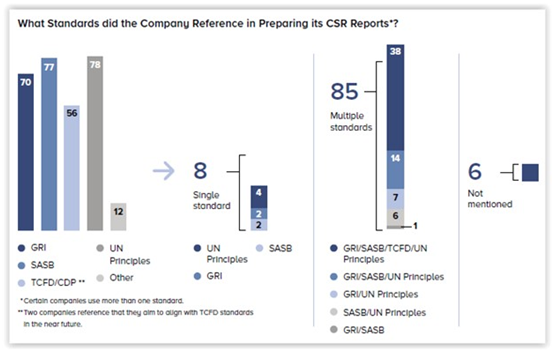
- Of those CSR reports that identified standards, most referenced multiple standards, as shown here:
- Nearly 75% of companies disclosed having a “Chief Sustainability Officer” (or other officer with a similar title).
- A majority of companies identified ESG factors as a skill set in their director skills matrix or narrative in their proxy statement - most commonly, human capital/talent management and development, diversity, and/or environment/sustainability.
- Just 11 companies did not disclose the board’s oversight of ESG matters in their proxy statement.
- Of the majority of companies that disclose their oversight structure, boards typically oversee ESG at both the board and committee levels. For those boards whose oversight structure includes a board committee, allocation of responsibility to the Nom/Gov Committee is the most common approach by a wide margin.
- Most companies disclose ESG oversight in committee charters or their corporate governance guidelines.
See the release and numerous additional benchmarking resources on our Board/Governance Practices, Annual Meeting/Proxy Statement, and other topic-specific pages.
This post first appeared in the weekly Society Alert!