“The AI-powered boardroom” from Governance Intelligence (sponsored by Diligent) provides data on the current state of play on the use of AI by directors and governance professionals with reference to recent surveys and workshops and offers sound suggestions for responsible implementation and use with due regard for good governance considerations.
Implementation checklist
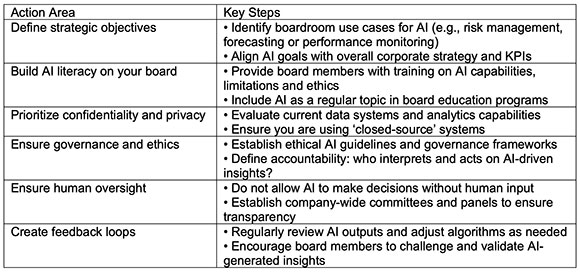
Informed by interviews with governance professionals, the report reveals use prevalence and the most common use cases, emphasizing the focus on using AI appropriately to enhance decision-making and efficiency for discrete types of tasks in lieu of other tasks that require human judgment.
The report addresses governance and risk considerations, including the proper use of AI in the context of directors’ fiduciary duties of care, loyalty, and oversight, as well as risks around data privacy, accuracy, and security, and the need for associated policies and training.
Practical action items include:
- Map current AI use — Identify where board or governance workflows already involve AI, intentionally or not (e.g., agenda drafting, information gathering).
- Develop an AI governance policy — Define approved tools, confidentiality protocols, human-in-the-loop safeguards, and audit trails.
- Prioritize secure, enterprise-grade tools — Avoid consumer AI products for sensitive board data until risk controls are in place.
- Educate and upskill — Provide regular briefings to directors and governance staff on AI capabilities, risks, and emerging regulation.
- Embed human oversight — Ensure AI outputs are reviewed and validated before inclusion in board materials or decision-making.
- Monitor the regulatory landscape — Monitor regulatory developments and, particularly for multi-jurisdictional companies, consider aligning practices with the most stringent standards/frameworks. At a minimum, identify the gaps between current practices and standards/frameworks.
The overall objective is to ensure that the company’s adoption of AI will enhance efficiencies, effectiveness, and competitiveness in a manner consistent with good governance and the preservation of trust, confidentiality, and accountability.
Access additional resources on our AI page.
This post first appeared in the weekly Society Alert!