Korn Ferry’s review and analysis of S&P 500 listed company 2025 proxy disclosures (conducted in partnership with Gibson Dunn) revealed a number of noteworthy insights and trends.
Disclosure prevalence—Of the 500 companies, 98% disclosed at least some information about their board evaluation process and 424 (87%) disclosed more detailed information regarding the nature of the assessment.
Evaluation scope—The majority of evaluations (53%) encompass the board, board committees, and individual directors; 41% address only the board and its committees; and 3% evaluate the board only.
Evaluation format—Of the companies that disclosed more detailed information, half utilize interviews as part of the evaluation.

Third-party facilitators—Nearly 40% of companies disclosed the use of third-party facilitators either periodically or annually (77% and 23%, respectively).
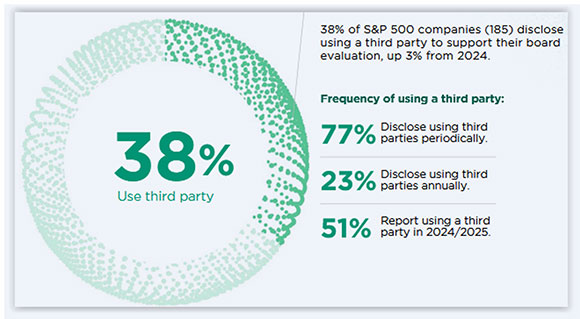
Of the 24% of companies disclosing the use of third-party facilitators that also disclose the type of third party used, 30 companies use consulting firms, 15 use law firms, and four disclosed the name of the third party.
Of the 61% of companies disclosing the use of third-party facilitators that also disclose how they use the third parties, 59% (66 companies) use third parties to help with interviews, 28% (31 companies) use them to facilitate and/or review written questionnaires / surveys, and 13% (15 companies) use them to assist with both written questionnaires / surveys and interviews.
Evaluation coverage—Of those companies disclosing the topics covered in their board evaluation (63% of companies), the top three topics identified were: (i) board and/or committee skills and composition (78%), (ii) board culture, dynamics, functioning, and/or operations (77%), and (iii) board and/or committee structure and responsibilities (73%).
Other topics addressed in 2025 include:
- Board/management dynamics (45%)
- Quality of information/materials to the board (42%)
- Strategic/financial/risk management oversight (39%)
- Board and/or management succession (36%)
- Agenda quality and appropriateness (36%)
- Director education (12%)
- Diversity, equity, and inclusion (8%)
Evaluation outcome/action plan—Nearly one-fifth of companies (18%)disclosed changes made following the evaluation—most commonly: modifying board and/or committee agendas and materials; changing board and/or committee structure and/or responsibilities; changing board and/or committee size and composition; and changing board succession planning and refreshment.
The report includes instructive commentary and guidance from Gibson Dunn on the benefits of a robust board evaluation process; commentary and guidance from Korn Ferry on the data and key components of an effective evaluation process; and a tabular summary of board evaluation requirements and standards around the world.