A recent report (summary here) from OxProx, a social venture spun out of Oxford University Innovation, in collaboration with Kaivalya Research, examines differences between how asset managers (AMs)—i.e., all institutional asset management firms—and asset owners (AOs)—including pension funds, sovereign wealth funds, endowments, insurers, and other beneficial owners—voted between July 1, 2024, and June 30, 2025.
Drawing on 4.57 million vote records from 464 institutional investors headquartered across the US, UK, continental Europe, Canada, Australia, and New Zealand, the report identifies notable differences in voting patterns across several proposal categories.
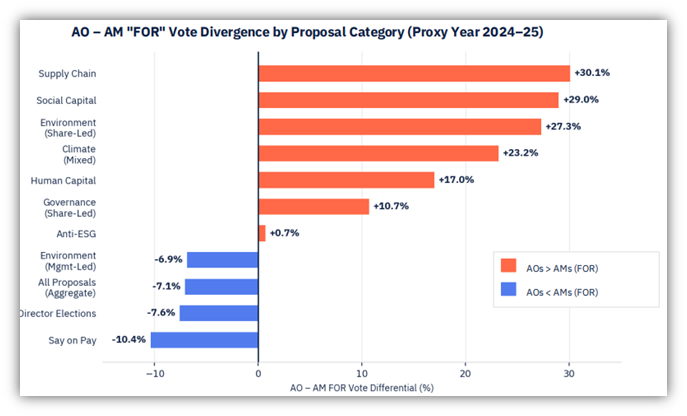
Among other findings, AMs supported director nominees at higher rates than AOs (85.7% vs. 78%), while AOs opposed director nominees at materially higher rates (16.8% vs. 10.4%). The report also found that AOs supported supply chain, social capital, and shareholder-led environmental proposals at rates approximately 27 to 30 percentage points higher than AMs, with similarly elevated support levels on climate change (23.2 percentage points) and human capital (17 percentage points) proposals.
The report frames these differences as part of a broader stewardship alignment issue, questioning the extent to which proxy voting by external managers reflects the priorities and long-term objectives of the underlying investors whose capital they manage.
Jasper Street, which highlighted the report in its recent Monthly Insights, observed that the findings may carry implications for companies as pass-through and “voting choice” structures—under which AMs transfer proxy voting authority to underlying clients, including institutional AOs—continue to expand (as reported, for example, here, here, and here), given that AMs, particularly US asset managers, tend to be among the most management-supportive voters.
This post first appeared in the weekly Society Alert!