The Society for Corporate Governance, in collaboration with Board Intelligence, released a new report, Board and Committee Meeting Materials: Insights, Practices, and Practical Guidance, offering a comprehensive look at how governance professionals plan meetings, prepare agendas, develop board materials, distribute information, assess effectiveness, and evaluate the role of artificial intelligence (AI) in the boardroom. The report draws on five Society member surveys, two member roundtables, and interviews with experienced governance professionals across public, private, nonprofit, and other organizations.
One message emerged consistently throughout the research: effective board meetings do not begin when directors enter the boardroom. They begin months in advance through disciplined planning, thoughtful agenda design, and careful curation of information.
Governance Is Becoming More Deliberate
The research shows that many governance teams are taking a longer-term view of board meeting preparation and effectiveness than ever before.
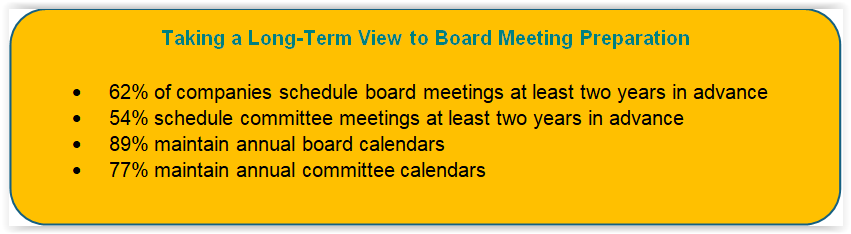
Nearly two-thirds of organizations schedule regular board meetings at least two years in advance, and more than half schedule standing committee meetings at least two years ahead as well. At the same time, 89% of organizations maintain annual board calendars or work plans, while 77% do the same for all standing committees.
These practices reflect a growing recognition that effective board discussions rarely happen by accident. Instead, they are the product of intentional planning, stakeholder alignment, and disciplined execution.
As one Society member explained: "After we get input from all the relevant management stakeholders, we have a two-year calendar in place that we put forward to the Board to approve on a rolling basis at the end of each year."
For governance professionals, the findings reinforce the value of annual board and committee work plans that align meeting schedules with strategic priorities, governance obligations, and director availability.
The Corporate Secretary's Role Continues to Evolve
Perhaps the report's most significant theme is the continuing evolution of the corporate secretary role.
Today's corporate secretaries are doing far more than coordinating logistics or compiling board books. Increasingly, they serve as information curators, helping management determine what directors need to know, how information should be presented, and where attention should be focused.
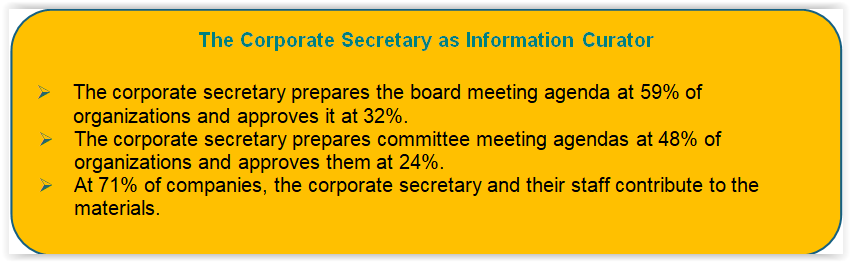
The data reflects that expanded role. Corporate secretaries are heavily involved in agenda development, materials preparation, review processes, and final board book approval. Seventy-one percent of organizations report that the corporate secretary or their team contributes directly to board materials, while many also provide training, templates, style guidance, and review support to authors and presenters.
One interview participant summarized the role this way: "Nothing gets on the agenda unless I, as the corporate secretary, put it there."
Another noted: "The corporate secretary and their team should take ownership of the materials even if they don't technically own them, for the good of the whole book."
The findings suggest that governance professionals increasingly act as facilitators of board effectiveness, helping ensure that materials are clear, concise, relevant, and appropriately focused at the board level.
Directors Continue to Struggle with Information Overload
While governance practices continue to mature, one challenge remains persistent: the volume of board materials.
The report found that governance teams are working to balance directors' need for comprehensive information with their limited time and attention. In fact, the report notes that a director serving on the board and multiple committees may receive hundreds of pages of materials in the days leading up to meetings.
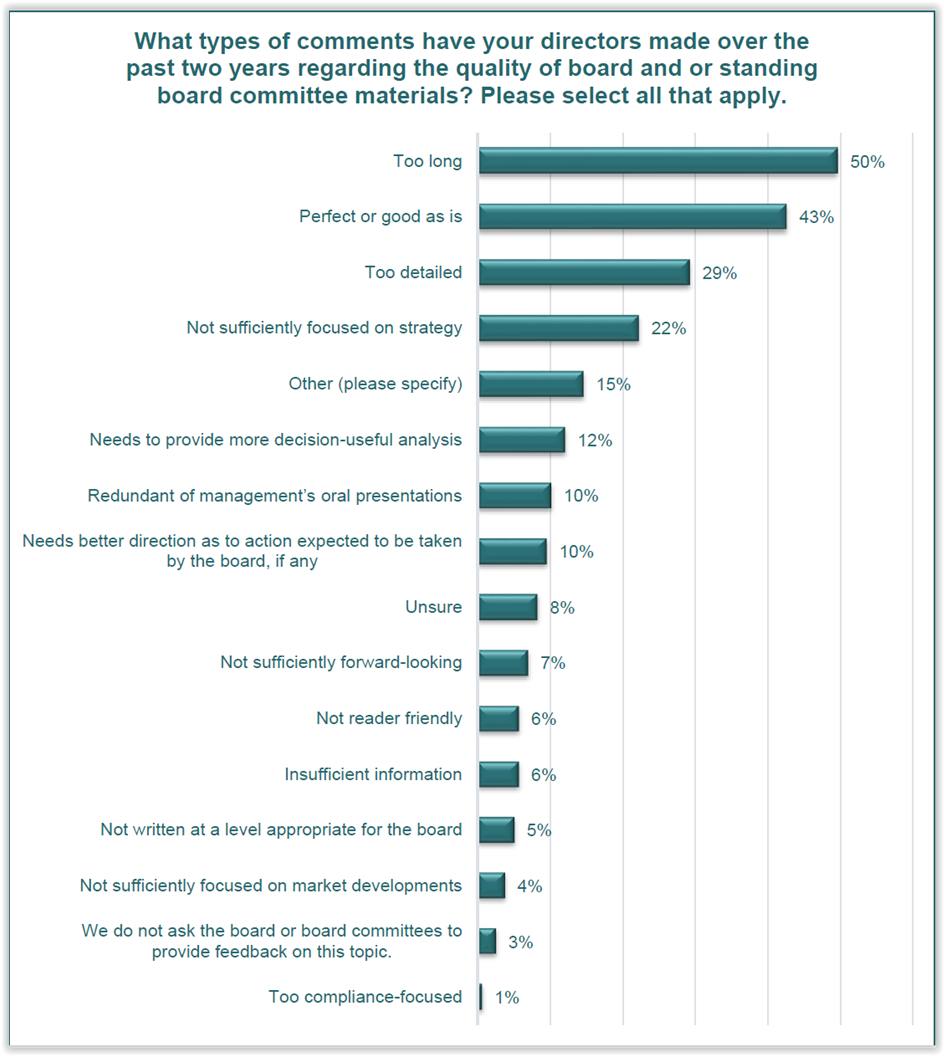
Director feedback suggests that many organizations still have work to do. Half of organizations report receiving feedback that board materials are too long. Nearly one-third report feedback that materials are too detailed, and more than one-fifth report concerns that materials are not sufficiently focused on strategy.
These findings may explain why many governance teams are increasingly adopting executive summaries, standardized templates, key-takeaway sections, and other tools designed to improve readability and focus.
One interview participant described their approach: "For most topics, we require a one- to two-page executive summary. We try to keep these concise, at a board level, so the topic is framed right and the board is warmed up."
The report's practical guidance encourages organizations to reduce unnecessary volume, distinguish discussion items from read-only information, and ensure that directors can quickly identify key decisions, risks, and strategic implications.
Better Materials Create Better Discussions
Another theme emerging from the research is that effective board materials are ultimately designed to support discussion rather than merely present information.
Several governance professionals emphasized the importance of helping presenters focus on key issues and reserve meaningful time for director engagement.
One interview participant offered advice that resonated strongly during the research: "If you're given 40 minutes, don't plan on talking for 40 minutes. Shut up after 20. Let the directors digest, test, and discuss."
This philosophy aligns with broader findings throughout the report. The most effective governance teams are not simply producing information; they are creating conditions for productive board conversations.
AI Is Coming—But Cautiously
AI remains one of the most discussed topics in governance today, but the research suggests that adoption remains measured.
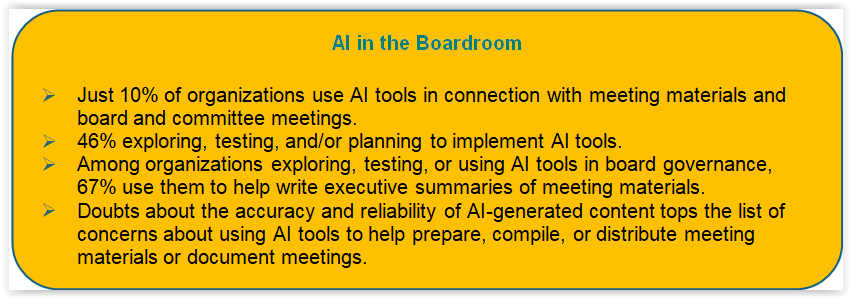
Only 10% of organizations currently use AI tools to prepare, compile, distribute, or document board materials and meetings. However, 46% report that they are exploring, testing, or planning implementation. Among organizations evaluating AI, common use cases include drafting executive summaries, summarizing background materials, and assisting with presentation development.
At the same time, governance professionals expressed significant concerns regarding accuracy, confidentiality, legal exposure, privilege, and data security. As a result, most organizations remain in the early stages of evaluating appropriate AI governance frameworks and safeguards. The findings suggest that while AI may become an increasingly valuable governance tool, organizations are proceeding thoughtfully and deliberately.
Practical Takeaways for Governance Professionals
Across the surveys, roundtables, and interviews, several practical themes consistently emerged:
• Plan further ahead than you think necessary.
• Maintain annual board and committee work plans.
• Involve key stakeholders early in agenda development.
• Provide clear guidance to authors and presenters.
• Reduce unnecessary volume in board materials.
• Use executive summaries and key takeaways to improve readability.
• Focus meeting time on discussion rather than presentation.
• Establish feedback loops to continuously improve materials and processes.
As boards continue to face increasing complexity and growing stakeholder expectations, governance professionals remain central to ensuring that directors receive the right information, in the right format, at the right time.
The full report includes additional survey findings, member perspectives, practical guidance, and sample tools that organizations may adapt for their own governance practices.