“CEO/Chair Leadership: When and Why Boards Combine or Separate the Roles,” published by The Conference Board in collaboration with ESGAUGE, the KPMG Board Leadership Center, Russell Reynolds Associates, and the University of Delaware’s Weinberg Center for Corporate Governance, examines CEO/chair leadership structures among S&P 500 and Russell 3000 companies based on 2025 proxy statement disclosures.
Among the key takeaways:
Combined CEO/chair structures remain more common at larger companies — In 2025, 42% of S&P 500 companies combined the CEO and board chair roles, down from 47% in 2020. Comparatively, 34% of Russell 3000 companies combined the role in 2025, up just slightly from 2024’s 33%.
Independent chair prevalence has remained relatively stable — While the proportion of independent chairs has changed modestly since 2020, Russell 3000 companies continue to be more likely than S&P 500 companies to maintain an independent board chair. In 2025, independent chairs were disclosed by 46% of Russell 3000 companies compared with 39% of S&P 500 companies.
Joint CEO/chair appointments at succession remain uncommon — Incoming CEOs are infrequently elected board chair at the time of transition. In 2025, only three of 65 S&P 500 CEO succession events (4.6%) and nine of 353 Russell 3000 succession events (2.5%) involved simultaneous appointment as board chair. From 2018–2025, such joint elections represented approximately 3% of S&P 500 successions and 2% of Russell 3000 successions.
Most companies preserve board discretion regarding leadership structure — Among companies disclosing a policy in 2025, 79% of S&P 500 companies and 71% of Russell 3000 companies indicated that boards retain flexibility to combine or separate the CEO and chair roles depending on circumstances. Explicit policies requiring either combined or separated roles remained comparatively uncommon.
Role-separation disclosures continue to emphasize distinct responsibilities — Among companies separating the roles, the most frequently cited rationale remained that the CEO and chair positions involve different responsibilities, cited by 74% of S&P 500 companies and 64% of Russell 3000 companies in 2025. The report also notes increasing references to the value of having two leaders with different perspectives and experience.
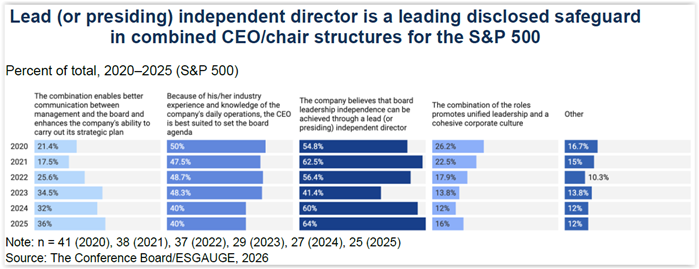
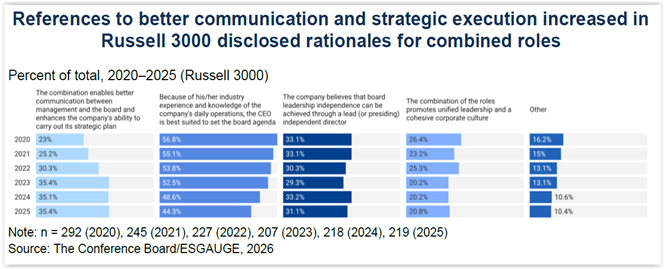
Combined-role disclosures emphasize governance safeguards and execution benefits — Among S&P 500 companies combining the roles, disclosures most commonly referenced the role of a lead (or presiding) independent director in supporting independent board leadership (64% in 2025). In the Russell 3000, the most commonly cited rationale remained that the CEO is best positioned to set the board agenda because of industry expertise and operational knowledge (44%), although references to improved communication between management and the board and enhanced strategic execution increased over the 2020–2025 period.
Investor and proxy advisor approaches continue to focus on independent board leadership — The report summarizes published positions of BlackRock, Vanguard, ISS, and Glass Lewis, noting that these organizations generally emphasize effective independent board leadership—either through an independent chair or a clearly empowered lead independent director—while evaluating CEO/chair separation proposals on a case-by-case basis.
Access additional resources on our Board Leadership page.
This post first appeared in the weekly Society Alert!