Board leadership succession planning receives far less attention than CEO succession planning despite the critical role board chairs and lead independent directors play in board effectiveness and CEO oversight. A recent Spencer Stuart pulse survey on board leader succession of more than 560 directors from US public and private company (66% and 34%, respectively) boards provides insight into how boards are approaching succession planning and leadership transitions.
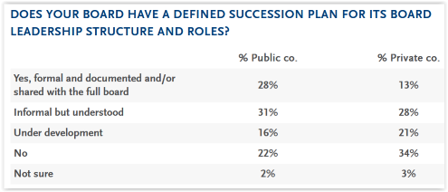
While most directors report some level of succession planning, relatively few boards have formalized the process. Only 28% of public company directors and 13% of private company directors say their boards have a formal, documented succession plan for board leadership that has been shared with the full board. Another 31% of public company boards and 28% of private company boards rely on informal but understood plans, while 22% and 34%, respectively, report having no succession plan.
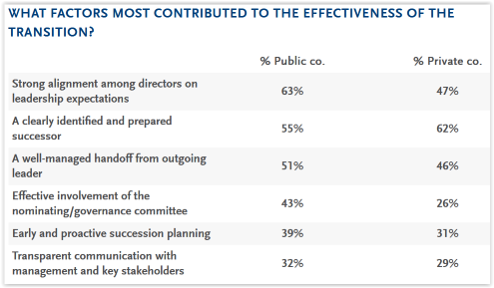
The survey also identifies factors directors believe contribute most to successful leadership transitions. Among boards that have expe rienced a transition, directors most frequently cite alignment among directors regarding leadership expectations, a clearly identified and prepared successor, and a well-managed handoff from the outgoing leader. Early succession planning and active involvement by the nominating and governance committee also ranked highly.
Responsibility for board leader succession planning most often lies with the nominating and governance committee with 60% of public company directors identifying that committee as having primary responsibility for the process, compared with 14% who cited the full board and 14% who pointed to the current board leader.
When evaluating future board leaders, directors emphasized a broad range of qualifications. Public company directors were more likely to prioritize prior board leadershi p experience, CEO experience, and interpersonal skills, while private company directors placed relatively greater emphasis on industry expertise, stakeholder credibility, and specialized skills.
A companion Spencer Stuart article recommends boards treat board leadership succession as a governance priority rather than an event-driven exercise. The authors recommend four actions: (i) formally assigning responsibility for succession planning, (ii) periodically evaluating the board leadership structure, (iii) establishing a deliberate process for selecting future board leaders, and (iv) regularly assessing leadership effectiveness and succession readiness.
See our recent report: “CEO/Chair Leadership Structures: Practices & Trends” and additional resources on our Board Leadership page.
This post first appeared in the weekly Society Alert!