A new EY Center for Board Matters report: “Inside the Effective Board: A Guide to Drive Board Performance” examines what directors believe drives board effectiveness, where boards are performing well, and where improvement is needed. Based on a survey of 107 directors and interviews with experienced board leaders, the findings suggest that while boards are confident in several core governance practices, many continue to focus on improving board composition, evaluation processes and information flows.
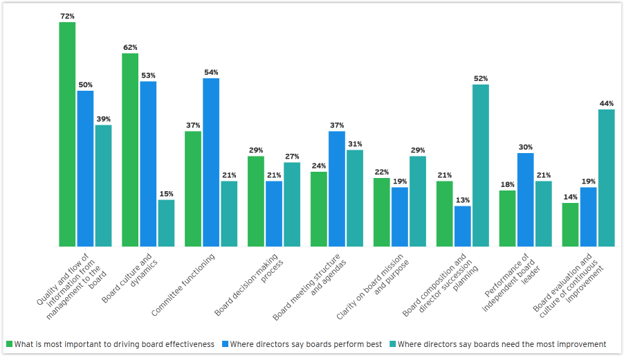
Among the factors directors identified as most important to board effectiveness, the quality and flow of information from management to the board ranked first (72%), followed by b oard culture and dynamics (62%) and committee functioning (37%). Directors also cited committee functioning (54%), board culture and dynamics (53%), and information flow (50%) as the areas where their boards perform best.
At the same time, directors identified several areas requiring greater attention. Board composition and director succession planning topped the list of improvement opportunities (52%), followed by board evaluation and a culture of continuous improvement (44%) and the quality and flow of information from management to the board (39%). Notably, information flow appeared on both the "strengths" and "needs improvement" lists, highlighting the wide variation in how boards assess the effectiveness of management reporting and board materials.
Looking ahead, directors identified AI and other emerging technologies as both the area where boards need to devote more time (65%) and the area where boards need more information and resources (73%). Talent ranked second on both measures, with 51% of directors seeking more board time devoted to talent issues and 47% seeking additional information and resources. Global political risk ranked third, cited by 29% of directors as warranting more board time and by 27% as an area where boards need additional information and resources. EY notes that these priorities reflect the growing influence of technological change on workforce, strategy, and risk oversight.
The report offers several practical pointers for boards. In the area of board composition, EY recommends maintaining an ongoing pipeline of potential director candidates and regularly updating board skills matrices to align with changing strategic needs. For board evaluations, the report encourages periodic use of third-party facilitators and stronger feedback mechanisms to support continuous improvement. To strengthen information flow, EY suggests clarifying when board decisions or input are required, increasing the use of executive summaries, and shifting more meeting time toward discussion by supplementing written materials with pre-recorded management briefings and periodic CEO or business-leader updates.
See our recent report: “What Makes Board & Committee Materials Effective?” and additional resources on our Board Practices page.
This post first appeared in the weekly Society Alert!