According to Mayer Brown’s memo: “AI Notetakers: Productivity Tool or Emerging Legal Risk?,” organizations should recognize that AI notetakers—that record, transcribe, summarize, and generate action items and which have quickly become a routine feature of virtual meetings—fundamentally change the nature of meetings by transforming conversations that might otherwise remain ephemeral into searchable, reusable, and often centrally stored data assets. Meeting transcripts and summaries may be integrated into enterprise systems, retained for extended periods, and accessed by individuals who were not present during the original discussion. The memo notes that AI-gene rated outputs may also be used in contexts such as performance evaluations, contractual negotiations, internal investigations, or strategic decision-making, creating potential risks if summaries omit nuance, mischaracterize discussions, or are relied upon beyond their original purpose.
The memo emphasizes that organizations should focus not only on whether meetings are recorded, but also on how those recordings are governed over time. Key governance considerations include participant awareness and transparency, the scope of permissible use, retention practices, vendor access to meeting data, and controls designed to prevent unauthorized secondary uses of recordings and transcripts. The authors provide a useful summary of common AI notetaker risks and corresponding governance considerations:
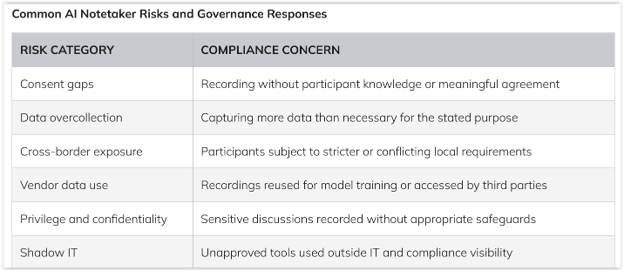
The memo further identifies several compliance principles that recur across regul atory frameworks. These include providing notice and transparency regarding the use of AI notetakers, establishing an appropriate legal basis for recording and processing information, limiting data collection and retention to what is necessary, conducting vendor due diligence, addressing potential biometric data implications, and evaluating cross-border data transfer requirements. The authors suggest that organizations may benefit from a principles-based governance framework that can be adapted to differing legal requirements across jurisdictions.
The memo further highlights jurisdiction-specific considerations in the US, EU, China, Brazil, and the UK.
Access additional resources on our Artificial Intelligence page.
This post first appeared in the weekly Society Alert!