Society members across industries responding to the latest Society/Deloitte “Board Practices Quarterly: Board use of AI” provided a snapshot of how boards are approaching the use of AI to support governance and oversight activities. The results suggest that while AI is becoming increasingly prevalent across organizations, board use remains in its early stages and related governance practices continue to evolve. The key takeaways below reflect primarily public company results; however, survey results are reported by company type (public/private) and size (public company market cap) in the Appendix of the report.
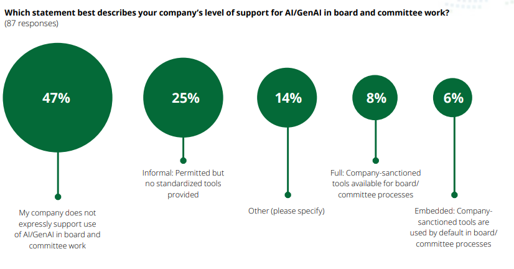
Board adoption – Board adoption of AI/GenAI remains at an early stage. Nearly half of public company respondents report that their companies do not expressly support AI/GenAI use in board and committee work, while organizations that do permit its use most commonly rely on informal approaches or company-sanctioned tools.
Meeting-related activities – Most respondents indicate that they are unsure whether their boards or board committees have recently used AI/GenAI in meeting-related activities. Among respondents aware of such use, known applications are concentrated in meeting-related activities such as analyzing reports, summarizing pre-read materials, preparing questions for management, and preparing discussion topics for meetings.
Oversight activities – Uncertainty regarding AI/GenAI use is particularly common with respect to board and committee oversight activities. Among respondents aware of such use, the most common applications include risk sensing, scenario analysis and planning, strategy review and development, and competitive landscape analysis.
Policies and governance practices – Most respondents report that their companies do not yet have board-specific AI/GenAI policies, guidelines, or governance practices. Where such practices exist, they most commonly focus on security, confidentiality, acceptable use, and legal, disclosure, and recordkeeping matters.
Risk management – Organizations are taking varied approaches to managing risks associated with directors’ use of AI/GenAI. The most common measures include discussions of AI-related risks during board or committee meetings and technical controls (e.g., board portal controls, watermarking, and download / copy restrictions), while one-third of respondents report that no specific measures are currently in place.
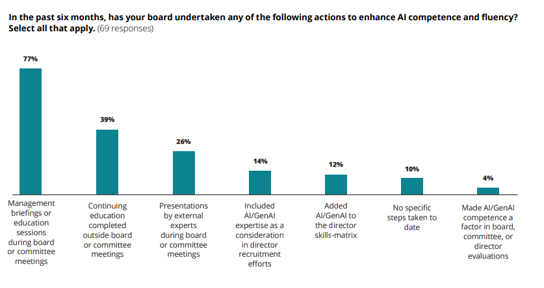
Building board AI fluency – The most common approaches to enhancing board AI competence and fluency include management briefings or education sessions during board or committee meetings, continuing education completed outside board or committee meetings, and presentations by external experts during board or committee meetings.
Access additional resources on our Artificial Intelligence page.
This post first appeared in the weekly Society Alert!