This annual report: “The State of Play: Sustainability Disclosure and Assurance—Six-Year Trends & Analysis,” from the International Federation of Accountants (IFAC) and AICPA & CIMA, evaluates sustainability disclosure and assurance practices among 1,400 of the largest companies across 22 jurisdictions worldwide. US data is based on an analysis of the largest 100 companies by market cap, with the updated report reflecting reporting year 2024.
Disclosure
Globally, 97% of companies reported some sustainability-related information in 2024. Companies continued to shift sustainability information into annual and integrated reports, which together accounted for 76% of reports, while standalone sustainability reports declined to 21%. Standalone reports nevertheless remained the most common reporting method in the US, South Korea, and Turkey.
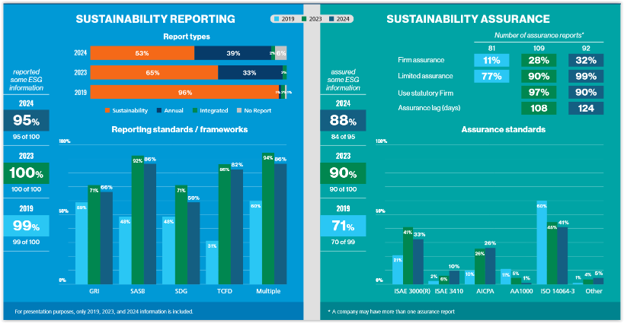
Among US companies, 95% reported some ESG information in 2024, down from 100% in 2023. Standalone sustainability reports remained the most common reporting vehicle but declined from 65% to 53%, while the percentage including sustainability information in annual reports increased from 33% to 39%.
United States
Assurance
Globally, 75% of companies reporting sustainability information obtained assurance over at least some of that information in 2024, up from 73% in 2023 and 51% in 2019. Limited assurance continued to predominate, representing 83% of assurance engagements. The report attributes much of the year-over-year growth in assurance to new mandatory requirements in Turkey and India.
Among US companies, 88% obtained assurance over some ESG information in 2024, compared with 90% in 2023. Nearly all US assurance reports—99%—provided limited assurance.
Audit firms issued 59% of assurance reports worldwide in 2024, up from 55% in 2023. In the US, audit firms issued 32% of assurance reports, up from 28%, although other service providers continued to provide the substantial majority. The report notes that the increase partly reflects fewer assurance reports per company being issued by other service providers.
In the US, assured information continued to lag companies’ financial audit reports substantially, with an average gap of 124 days in 2024, up from 108 days in 2023 and the largest gap among the jurisdictions reviewed.
Standards/Frameworks
For the first time in the report’s six-year history, the percentage of companies using multiple sustainability reporting standards or frameworks declined, from 92% in 2023 to 90% in 2024. References to the GRI Standards, UN Sustainable Development Goals, and the TCFD framework also declined globally, largely reflecting the first-time implementation of the ESRS under the CSRD.
At the same time, 33% of companies referenced current or future use of the ISSB’s IFRS S1 and IFRS S2 standards, more than double the 16% reported in 2023, and 20% referen ced current or future use of ESRS. ISSB references appeared in all 22 jurisdictions reviewed.
Among US companies, 86% referenced or used multiple standards or frameworks in 2024, down from 94% in 2023. Use or reference of the SASB Standards declined from 92% to 86%; the TCFD framework declined from 86% to 82%; GRI declined from 71% to 66%; and the UN SDGs declined from 71% to 59%.
Access additional resources on our Sustainability and Climate Risk & Disclosure pages.
This post first appeared in the weekly Society Alert!