|
A new report from The Conference Board: “Emission Impossible: Corporate Climate Goals Moving from Adoption to Execution” suggests that the conversation around corporate climate goals is shifting from whether companies have established targets to whether those targets remain achievable—and, if not, how companies should govern, communicate, and disclose any resulting changes.
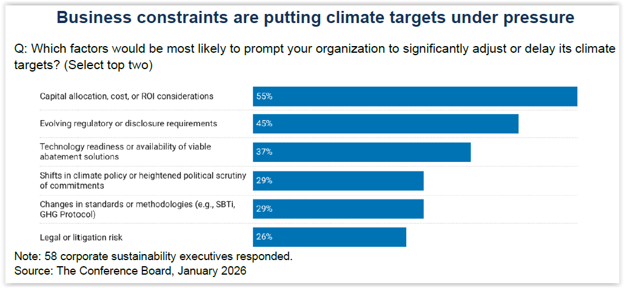
According to a survey of corporate sustainability executives, financial considerations were the leading factor respondents i dentified as likely to prompt their organizations to adjust or delay climate targets, with 55% citing capital allocation, cost, or ROI. Other leading factors included evolving regulatory and disclosure requirements and technology readiness or the availability of emissions-reduction solutions, along with legal and litigation risk, changing standards or methodologies, and increased public scrutiny. The report notes that climate initiatives increasingly compete for capital with AI, cybersecurity, digital transformation, capacity expansion, supply-chain resilience, and other strategic priorities.
The report emphasizes that changes to climate targets should not automatically be viewed as a retreat from climate commitments. Rather, companies should distinguish among three different types of changes:
- Technical recalibration, reflecting updates to baselines, methodologies, boundaries, or reporting structures while maintaining the underlying level of ambition;
- Feasibility resets, involving revisions to timing, scope, or targets because original assumptions regarding capital, technology, business conditions, or other factors have changed; and
- Strategic retreats, involving reductions in ambition or elimination of targets without a credible replacement plan, which the report suggests present the greatest reputational, legal, commercial, and employee-relations risks.
The report also posits that material changes to climate targets be reviewed through a cross-functional governance process involving sustainability, finance, legal, operations, IR, communications, relevant business units, and the board.
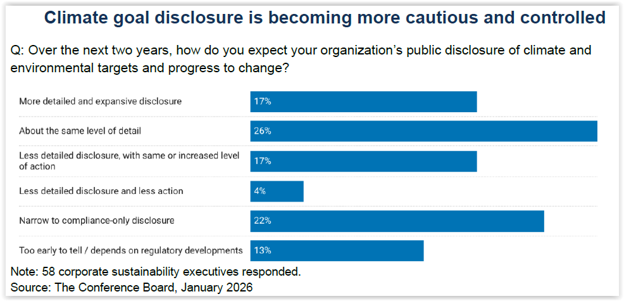
The report also suggests that companies are becoming more deliberate in how they communicate climate goals and related disclosures. Based on the survey, it observes that companies generally expect climate disclosures to become more detailed or increasingly compliance-driven, while relatively few anticipate reducing climate-related disclosure altogether.
The Conference Board notes that the most credible climate goal disclosures distinguish between long-term ambitions, specific measurable targets, actual progress, and the uncertainties that could affect future performance. It also recommends that companies clearly explain the reasons for changes to climate targets—including whether they reflect a technical recalibration, feasibility reset, or reduction in ambition—and notes that external assurance over emissions data, while increasingly common, does not by itself demonstrate that a company is on track to achieve its climate goals.
The report also examines trends in corporate climate-target adoption, GHG emissions reporting, progress and execution challenges associated with Scope 1, Scope 2, and Scope 3 emissions, environmental goals beyond climate, and practical recommendations for governing, reassessing, and communicating climate commitments as companies move from target setting to implementation.
Access additional resources on our Climate page.
This post first appeared in the weekly Society Alert!
|