JUST Capital’s new report reveals trends in human capital data disclosure among the 100 largest US employers (more than one-third consisting of consumer discretionary companies) across 28 metrics within five of the six aspects of human capital it characterizes as broadly defining different facets of human capital based on GRI, SASB, and other third-party standards. Notably, the metric categories appear to closely track the areas SEC Chair Gary Gensler has identified as potential candidates for the SEC’s forthcoming human capital disclosure rulemaking proposal: (i) Employment and Labor Type, (ii) Job Stability, (iii) Wages, Compensation, and Benefits, (iv) Workforce Diversity, Equity, and Inclusion, (v) Occupational Health and Safety, and (vi) Training and Education.*
In his prepared remarks at London City Week in June (we reported on here), Chair Gensler said that the SEC’s human capital proposal “could include a number of metrics, such as workforce turnover, skills and development training, compensation, benefits, workforce demographics including diversity, and health and safety.” Chair Gensler reiterated these metrics in an August 18 tweet.
The report includes this table of metrics that fall under each of the six themes:
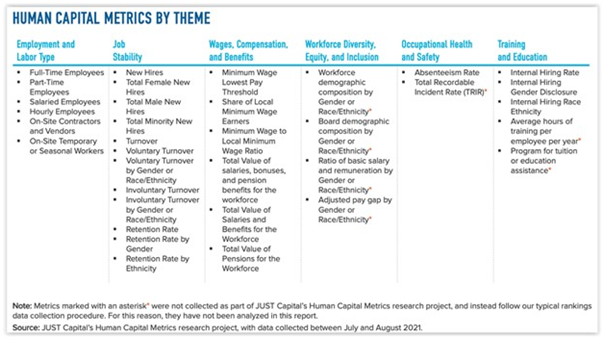 Workforce DE&I disclosure was not included in this report due to differences in manual data collection for certain metrics; however, JUST Capital fairly recently reported on workforce DE&I disclosure separately (which we reported on here).
Based on its analysis, JUST Capital concluded: (i) disclosure rates vary across metrics and no metric is reported by a majority of companies; (ii) the majority of human capital metrics are currently disclosed in CSR or sustainability reports (56%) rather than in the Annual Report or Form 10-K (28%) or other mediums; and (iii) metrics with the highest levels of public disclosure are more likely to be reported in Annual Reports or Form 10-K filings. Metrics with disclosure rates of at least 20% include total value of salaries and benefits for the workforce (42%); total value of pensions for the workforce (38%); full-time employees (38%); part-time employees (31%); total female new hires (24%); and minimum wage/lowest pay threshold (20%).
*See the research methodology here.
Access additional resources on our Human Capital/Workforce Management page.
This post first appeared in the weekly Society Alert!